¿Cómo elegir el tubo termorretráctil de capa ondulada adecuado para empalmes de cables de media tensión?
El tubo termorretráctil de capa rasgable es un material funcional en el sistema de aislamiento de empalmes de cables. Por lo tanto, además de los parámetros del producto, al comprarlo, también debe asegurarse de que el proveedor cuente con capacidad de producción continua y control de calidad.CCMT se fundó en 1986 y cuenta con una planta de producción de aproximadamente 10 000 m² y más de 40 equipos de producción profesionales. Su capacidad de suministro mensual de productos termorretráctiles es de aproximadamente 5 millones de metros. Hemos implementado un sistema de gestión de calidad ISO 9001:2015 y llevamos a cabo un riguroso control de calidad de las materias primas, los procesos de producción y los productos terminados.En cuanto a nuestra experiencia en proyectos, hemos suministrado productos accesorios de cables termorretráctiles relevantes para la central nuclear de Hainan, la central nuclear de Tianwan, la central nuclear de Taishan, la central nuclear de Ling'ao y la central nuclear de Fangjiashan.
La importancia de este tipo de información no radica en probar que un determinado modelo de producto sea naturalmente adecuado para todos los proyectos, sino en ayudar al comprador a determinar si el proveedor tiene capacidad de confirmación de especificaciones, control de calidad, producción en masa y suministro de proyectos.
Conclusión: Se recomienda seguir estos cuatro pasos para confirmar la selección de empalmes de cables de media tensión.
Si se simplifica aún más todo el proceso de adquisición y se selecciona un tubo termorretráctil compuesto coextruido de tres capas para la unión del cable de media tensión, se pueden seguir los siguientes pasos:
1. Confirme primero el nivel de voltaje.2. Mida el diámetro exterior máximo y la longitud de cobertura de la junta.3. Compruebe la relación de contracción, la temperatura de funcionamiento y los datos de prueba.
4. Finalmente, confirme la capacidad de producción y de suministro del proveedor para el proyecto.
Si está seleccionando uno adecuado
Tubo termorretráctil con capa ondulada
Se recomienda que nos proporcione el voltaje completo del cable, el tamaño del conector y los requisitos técnicos del proyecto, y nosotros nos encargaremos de ajustar las especificaciones finales para usted.
· Length of joint to cover
· Relevant standards or technical specifications adopted by the project
In this way, suppliers can further confirm product specifications and recommend more suitable products.
Select the Size Based on the Maximum Outer Diameter of the Joint Rather Than Simply Based on the Outer Diameter of the Cable.
After the cable joint is installed, its maximum outer diameter is usually different from the original cable outer diameter. If you only select heat shrink tubing based on the outer diameter of the cable itself, problems such as failure to fit the joint, insufficient fit after shrinkage, or insufficient effective coverage may occur.
Therefore, when selecting a model, it is recommended to focus on measuring the maximum outer diameter of the joint, the length to be covered, and the actual transition size at both ends of the cable.
Specifications currently provided by CCMT include:
| Reference Specifications | Minimum Inner Diameter Before Recovery (Mm) | Inner Diameter After Recovery (Mm) | Nominal Wall Thickness (Mm) |
| 35/13 | 35 | 13 | 11.0 |
| 45/17 | 45 | 17 | 12.0 |
| 50/21 | 50 | 21 | 12.7 |
| 63/26 | 63 | 26 | 13.5 |
| 75/34 | 75 | 34 | 13.5 |
| 95/42 | 95 | 42 | 14.2 |
| 110/52 | 110 | 52 | 14.2 |
| 125/62 | 125 | 62 | 15.0 |
This series of products also adopts a 2.5:1 shrinkage ratio, which supports specification confirmation and shrinkage ratio customization based on the actual cable and joint structure. Therefore, when purchasing in bulk, it is recommended not to only provide the "cable model", but to directly provide the supplier with the maximum outer diameter and covering length of the joint, which is more conducive to quick confirmation of specific specifications.
Not Only Look at the Contraction Ratio, But Also Focus on Long-Term Resilience.
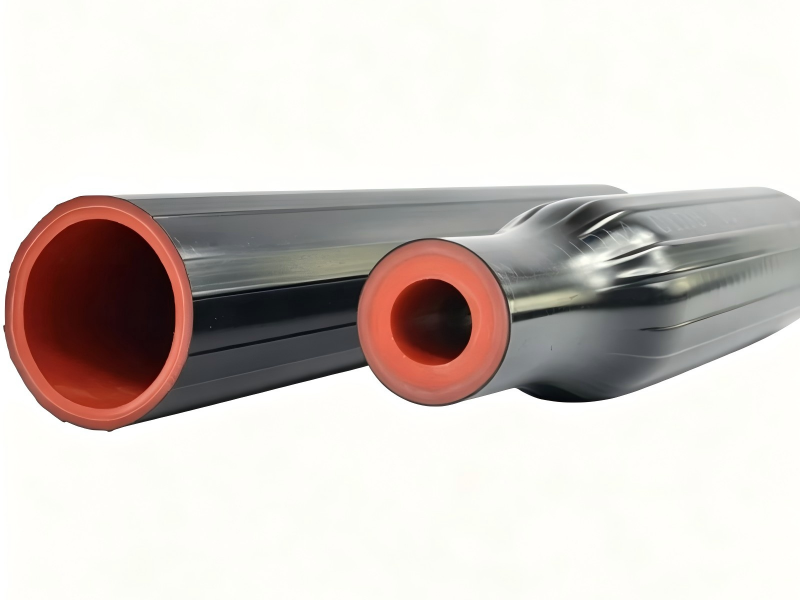
During cable operation, it will be affected by load changes and temperature changes, and the insulation layer may undergo repeated thermal expansion and contraction. If the external material is not tough and stretchy enough, issues such as the interface pressure getting lower and the opening getting larger might appear over time after repeated usage. When purchasers choose riple layer heat shrinkable tubing, they should pay attention to whether the product adopts a cross-linked thick-walled structure and a material system with continuous recovery capabilities.
Taking CCMT's products as an example, it adopts a cross-linked thick-walled structure and co-extrusion design of semiconductive layer, insulating layer and elastic layer, so that the tube body can continue to maintain a certain radial restoring force after shrinking, and at the same time adapts to the cable insulation layer due to temperature changes. size changes. This is also one of the important differences between three-layer structure products and ordinary single-layer insulation heat shrink tubing in cable joint applications.
Check the Test Data Instead of Just Looking at "Good Insulation Performance".
For large-scale purchases, the test data provided by suppliers is more valuable than the simple description of "high insulation, aging resistance". For example, CCMT's riple layer heat shrinkable tubing has corresponding test data for different functional layers:
Inner layer:
· Tensile strength ≥6 MPa
· Elongation at break ≥400%
· Dielectric strength ≥15 kV/mm
· Volume resistivity ≥1014 Ω·cm
· No cracking in-55 ° C low-temperature flexibility test
Intermediate insulation layer:
· Tensile strength ≥10.5 MPa
· Elongation at break ≥400%
· Dielectric strength ≥15 kV/mm
· Volume resistivity ≥1013Ω·cm
· No cracking during thermal impact at 200°C/30 min
Outer layer:
· Tensile strength ≥20 MPa
· Elongation at break ≥350%
· Tensile strength ≥16 MPa after aging at 158°C/168 h
· 250°C/30 min thermal impact No cracking, no dripping, no flow
In addition, the thermal aging performance of our products is tested with reference to IEC 216, and the halogen content of the material meets the requirements of IEC 61249-2-21. These data can help buyers judge products from the perspectives of mechanical properties, electrical insulation, heat resistance and long-term use adaptability.
Pay Attention to the Operating Temperature and Actual Installation Temperature of the Product.
"How much temperature can the three-layer heat shrink tube withstand" and "How much temperature is needed for installation" are two different questions. Take our products as an example, with an operating temperature range of-55°C to 105°C and an installation shrinkage temperature of 135 - 150°C.
Therefore, purchasing and installation personnel need to confirm separately:
· Whether the project operating environment is within the product operating temperature range;
· Whether the on-site heating tool can meet the shrinkage temperature specified by the product;
· Whether the joint structure allows uniform heating;
· Whether the heat shrinkable product can completely cover the target area.
Especially in batch engineering projects, product parameters and on-site installation process should be confirmed at the same time. Otherwise, if specifications are chosen properly, an inappropriate installation environment might interfere with the results.
What Information Is Recommended to Provide to Suppliers at One Time When Purchasing?
If you want to quickly obtain accurate riple layer heat shrinkable tubing specifications, you can provide the following information when making an inquiry:
| Information to Be Confirmed | Procurement Role |
| Cable Voltage Rating | Confirm the applicable electrical grade of the product |
| Cable Outer Diameter | Determine the transition size at both ends |
| Maximum Outer Diameter of the Joint | Confirm shrinkage range of heat shrink tubing |
| Joint Coverage Length | Confirm product length |
| Joint Structure/Installation Photos | Assist in judging the actual structure |
| Project Standards | Validation testing and technical requirements |
| Estimated Procurement Quantity | Convenient for suppliers to arrange batch production |
For joints having complicated configurations or not of the industry standard size, physical images, construction drawings and dimensions at location of installation must be supplied.
Why Is the Supplier's Testing and Project Experience Worthy of Being Included in Purchasing Judgment?
Rip layer heat shrinkable tubing is a functional material in the cable joint insulation system. Therefore, in addition to product parameters, when purchasing, you should also understand whether the supplier has continuous production and quality control capabilities.
CCMT was established in 1986 and has a production base of approximately 10,000㎡ and 40+ professional production equipment. The monthly supply capacity of heat shrink products is approximately 5 million meters. We have established an ISO 9001:2015 quality management system and carry out quality control of raw materials, production processes and finished products.
In terms of project experience, we have provided relevant heat shrinkable cable accessory products for Hainan Nuclear Power Station, Tianwan Nuclear Power Station, Taishan Nuclear Power Station, Ling 'ao Nuclear Power Station and Fangjiashan Nuclear Power Station.
The significance of this type of information is not to prove that a certain model of product is "naturally suitable for all projects", but to help the purchaser further determine whether the supplier has specification confirmation, quality control, mass production and project supply capabilities.

Conclusion: It Is Recommended to Follow These Four Steps to Confirm the Selection of Medium Voltage Cable Joints.
If the entire procurement process is further simplified and three-layer co-extruded composite heat shrink tubing is selected for the medium voltage cable joint, the following steps can be followed:
1. Confirm the voltage level first
2. Measure the maximum outer diameter and covering length of the joint
3. Check shrinkage ratio, operating temperature and test data
4. Finally confirm the supplier's production and project supply capabilities.
If you are selecting a suitable riple layer heat shrinkable tubing, it is recommended to provide us with the complete cable voltage, connector size and project technical requirements, and we will match the final specifications for you.
¿Por qué es importante tener en cuenta la experiencia del proveedor en pruebas y proyectos a la hora de tomar una decisión de compra?